what ever happened to hollie off of hells kitchen

By , Contributing Editor, Computerworld |
Well-nigh |
Non your average Android news — a diverse mix of advice, insight, and analysis with veteran Android journalist JR Raphael.
Android Intelligence Analysis
What the hell is happening with Android One?
Google's once-pivotal program for exceptional yet affordable Android phones seems to exist fading — and perchance for good reason.
Non long ago, a low-profile program called Android One looked similar it could be just the i-2 punch Android needed.
Android One, similar lots of Google initiatives, has had a long and winding history with plenty of twists and turns. When Android One outset came into the flick in 2014, it was described equally an attempt to "make high-quality smartphones accessible to as many people as possible." The focus was squarely on bringing affordable phones with exceptional experiences to emerging markets — places like Pakistan and India, where it could be "hard for people" to "become their easily on a loftier-quality smartphone," as Google put it at the time.
Simply that was just the kickoff of Google's Android One ambitions. Iii years later, in 2017, Google expanded the program with the launch of Android 1 phones in places similar Japan, Taiwan, and eventually the The states. The company changed its description of the endeavor from that original small-scale-scale focus to the much broader vision of a "collaboration betwixt Google and [its] partners to evangelize a software experience designed by Google," with a guarantee of reasonably timely ongoing operating arrangement updates and an experience that'd be gratis from all the bloat and shenanigans baked into so many Android products.
Sound familiar? It should. It'due south basically the same concept nosotros see with Google's own cocky-fabricated Pixel phones, only scaled down a bit and with other manufacturers involved. Or, to zoom dorsum even further into Android nerdland, information technology's incredibly similar to what we used to run across with Google's Nexus phones many moons ago — where Google would bring in other telephone-makers to handle the hardware only then maintain complete control over the software, back up, and overall user experience itself. (In the Nexus scenario, of grade, the phones were branded as Google devices. But that surface-level distinction bated, the state of affairs is nigh eerily comparable.)
Over the last few years, Android I has grown more and more mature, with a lineup of impressively decent budget-level and even midrange devices made by the likes of Nokia, LG, Motorola, and a handful of other companies. Those phones have consistently been ahead of the pack when information technology comes to the e'er-important area of Android upgrades, with post-sales support that puts most other options — including those that cost 4 to 5 times as much — to shame.
Lately, though, something foreign has been happening. The once-thriving Android One program seems to accept quietly faded into an almost forgotten footnote. The pace of new devices showing up in the program'southward virtual shelves has slowed downwardly to a trickle, and the phones that are nonetheless live and kickin' within the Android 1 walls are failing to meet their one-time promises of fast and frequent software updates.
And then what in the globe is happening? I'm a curious creature, and I plant myself scratching my wooly man-noggin to lilliputian consequence (bated from itch satiation) trying to figure it out. So I decided to dig a little deeper to see what I could find. And, well...
The Android One oddness
Let's first with the starting time front — the dearth of contempo Android Ane devices and the apparent lack of attention Google is devoting to the programme (a programme for which it had previously promised to provide "major promotional dollars," according to a 2017 report).
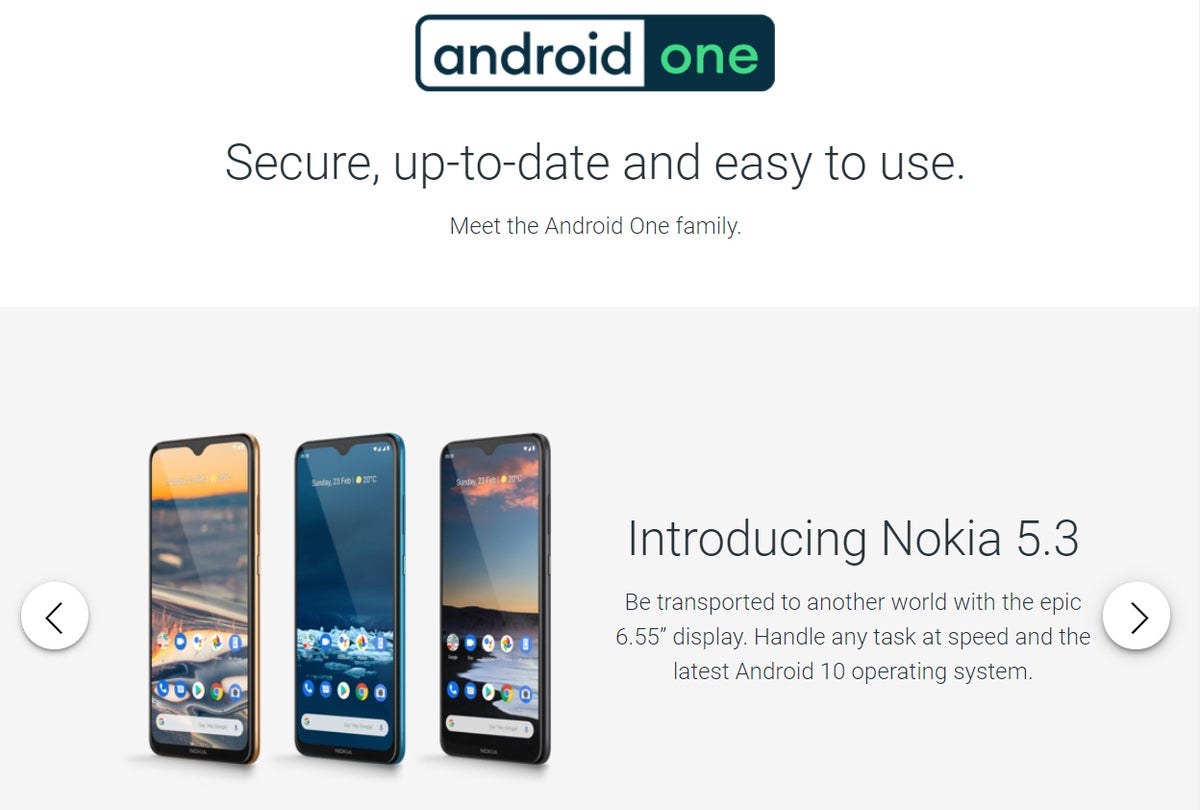
All y'all've gotta practice is look at Google's official Android One website to run into the unavoidable signs that something unusual is afoot. Right nether the meridian-of-page headline promising phones that are "secure, upwardly-to-date, and easy to use" is a graphic showing the Nokia five.3 — a phone that was announced an entire year ago, concluding March, and is yet running 2019's Android 10 software, about seven months afterward Android 11's release. Yeaaaaaaaaah. I'm no mathematician, but something sure doesn't seem to add up.
And the disconnect only gets even more blatant from there: That primary forepart-and-middle graphic with the Nokia 5.three actually describes the phone as having "the latest Android 10 operating organisation" — despite the fact that Android 10 hasn't been "the latest" Android version since terminal September. Um, right.
 Google
 The other "latest phones" featured on the page aren't whatsoever improve. One of the top devices shown on the Android One landing page, the Motorola One Activeness, came out at the stop of October — in 2019. It too has however to receive the now-7-calendar month-former Android 11 update, despite beingness part of the Android One program.
Motorola, for its part, seems to take mostly simply moved on from its Android One focus. Confusingly, it's continued to release devices with that 1 branding as part of their titles — like last year'southward Motorola One Fusion and Motorola Ane Hyper — but it'due south seemingly reclaimed that branding as its own, without any of the Android One associations or promises.
So what about Nokia — the company that went all in with Android One and that I once labeled as the "unlikely new Android underdog"? I reached out to that company's media relations department multiple times over the past week to ask for an explanation on both its unprecedented failure to provide timely updates to its current crop of Android One phones and its sudden slowdown in new Android One device releases, and I've withal to receive whatever response.
What nosotros tin say is that first, Nokia's had some public struggles over the past months — with reports terminal February that the company could be "exploring strategic options," including a possible sale or merger. (Those reports were after shot down, merely the fact that such talk is even out in that location is never a great sign.) But this by Friday, the company'southward primary production officer and one of its most prominent public figures announced his difference — which may or may not have whatever direct connection to whatever'south going on with all of this, merely again, doesn't help with the perception of an organization that's adrift.
Equally for Google, I asked the company if there was annihilation it could share nigh whether Android I was however considered an active attempt — and if so, what exactly was going on with (a) the considerable slowdown in new phones coming out within the Android One umbrella and (b) the apparent failure by practicallyevery existing Android One device-maker to meet its timely software update promise in this latest upgrade cycle. In response, a company spokesperson sent me the following statement:
Android I is a living program that continues to grow with successful device launches. New phones that meet the elevated software requirements set past Google will exist able to be part of the plan in the future. And equally before, these devices come with security protection integrated into every layer, ongoing updates, and a simple interface free of duplicate apps. While we have nothing to announce regarding the future of the Android I plan today, we volition continue to piece of work with our partners to bring smashing Android devices to market.
I pressed a bit further and asked if there was anything more specific that could be said to explain the situation with all of the yet-pending Android One software updates, some seven months after Android 11's release, as well as with the recent lull in new Android-One-associated device releases — but I haven't received any additional responses.
There is, of grade, one perfectly logical possible explanation to all of this — a narrative that ties all the pieces together and certainly seems like a sensible answer to why Android One has gone from front and center to faded and forgotten. Rev upwards that beautiful mammal brain of yours: It'due south fourth dimension to explore an all-likewise-plausible-seeming theory.
The bigger Android One picture
Stay with me for a sec, 'cause there's some important context we need to think through to set the stage for this sudsy lather-opera drama. Back when Android One offset expanded from its initial "emerging market" focus, y'see, my favorite writer in the world — an extraordinarily handsome and apprehensive fella — fabricated some astute observations nigh how the program could be the brilliantly conceived missing piece to Google'due south grand Android puzzle.
Become, go, gadget quoting motorcar:
Android can remain open and bachelor for manufacturers to customize every bit they wish — something that's been integral to the platform's success since the start. Customers tin choose from a diverseness of styles and forms, as always, and each volition offer its own unique set of advantages. But at present, telephone-seekers who want a Google-controlled vessel with all the benefits that approach provides will also have that as a fully realized, consumer-set choice.
Google already provided that same possibility with its own self-made Pixel phone, of class — simply at the time, Google was selling only a unmarried high-end (and high-priced, for that era) Pixel model. That meant the majority of telephone buyers were never gonna get the Android experience Google clearly saw as existence optimal — one that's cohesive and easy to use, that puts complementary Google services front and center, and that remains fresh and compelling for an extended menstruum of time by way of reliable updates.
And that'southward where Android I came into play: Past offering a "Pixel calorie-free" sort of experience at an affordable toll, Google could bring its vision for how it wanted Android to appear to a much larger base of people — despite the fact that it wasn't ready to make its own lower-priced Pixel model at that indicate.
To quote my favorite apprehensive writer over again:
Google could accept its cake and eat it, too: It could give consumers an choice for a amend overall user experience — its own vision for Android, just at present inside upkeep- to midrange-level parameters — while however allowing manufacturers to exercise their ain thing as an alternative. And dissimilar on the high-stop of the spectrum, where every detail counts and a finely tuned holistic feel is part of the package, letting third-party phone-makers retain some corporeality of branding and control of these lower-cost devices is a compromise Google tin afford to make.
So what's changed since then? Ding, ding, ding! You got information technology: Google started making its own affordable Android telephone with its ideal software setup and self-controlled, super-speedy software updates. That's precisely what the Pixel "a" line is all well-nigh, and with a toll of 350 bucks, it brings the same optimized feel nosotros first saw in the loftier-end Pixel into a much more affordable form. Itis the "Pixel lite," without whatever of the asterisks Android Ane involves in comparison.
With Google selling its own completely self-controlled Pixel phone for 350 smackeroos, then, what reason does it have left to really, truly care about Android One in the fashion it in one case did? The entire reason Android One originally benefitted Google is made more often than not redundant and unnecessary by the Pixel "a" line's existence. For the virtually part, an Android One phone is a watered-down, bottom version of a Pixel "a" device, and information technology'southward typically sold for pretty darn close to the same price (sometimes fifty-fifty more).
When you lot combine that fact with the shifting Android mural — what we talked about a minute ago with Nokia combined with LG'southward potentially fatal current struggles, one-time Android Ane partner HTC'south increased irrelevance, and the lack of any real motivation for an already-successful-on-its-ain phone-maker similar Samsung to participate in this sort of effort — it kinda makes sense that Android One would beginning to fizzle, doesn't it?
I mean, call up well-nigh: The program'due south most prominent players are all having their own issues, and Google simultaneously now has its own fully cocky-controlled product to serve the program's original purpose even more effectively. It also has the ultra-low-finish-focused Android Go program to address the super-affordable, sub-$200 domain that the Pixel line doesn't (yet) cover. Really, it's no wonder the Android Ane promise and everything around it seem more often than not out of mind.
And you know what? This is absolutely reading between the lines, just if you look dorsum at Google'south statement on the discipline, it seems well-nigh deliberately worded to avoid proverb annihilation substantial about the program's long-term fate. Yeah, information technology says that Android One is a "living programme that continues to abound" — simply expect closely at that final line (the emphasis hither beingness mine):
While we have nothing to announce regarding the future of the Android I program today , we will continue to piece of work with our partners to bring great Android devices to market place.
Nothing to announce most the program'south future today? That certain isn't the aforementioned as proverb "This program isn't going anywhere, bucko!" And standing to work with partners to bring great Android devices to market? Note the lack of a mention of Android I, specifically, equally part of that proposition.
When I wrote well-nigh Android One's potential back in 2017, I noted how the effort could fill the then-glaring void of an optimal Google experience within Android at the sub-flagship price range. Equally I said at the fourth dimension:
Google may not desire to invest the resources in developing its ain devices at every level of the Android price spectrum. Creating a comprehensive line of products would be costly, for one, and it'd risk alienating and irritating tertiary-political party manufacturers even more than it (probably) already has. For now, at to the lowest degree, this could be a clever way to accomplish a good-enough-for-the-affordable-realm goal while getting merely involved enough to maintain critical cadre standards.
Well, approximate what? Here we are, iv years afterward — and Google has taken that aggressive spring into the affordable Android phone market place. It has invested the resource in developing its own devices at lower cost points, and past virtually counts, the first Pixel "a"-line phones have sold quite well, relatively speaking.
Google may not be set up to pull the plug on Android One yet, simply looking at all the variables surrounding the land of the program, information technology's hard non to wonder if the clock is already ticking — and, in one manner or another, if it's but a affair of fourth dimension until the seconds run out.
Want even more Googley knowledge? Sign upwards for my weekly newsletter to become next-level tips and insight delivered directly to your inbox.

Copyright © 2021 IDG Communications, Inc.
Source: https://www.computerworld.com/article/3613511/android-one.html
0 Response to "what ever happened to hollie off of hells kitchen"
Post a Comment